Thursday, November 21, 2013

Vivisected for your magazine essay: American Mary (2012) and S&man (2006).


American Mary (2012) deserves credit for being one of the few films where I really had no idea what was going to happen next. It's a unique, stylish, and surprising chronicle of the title character's descent into slasher movie madness—but it's also a bit of a mess, both literally and figuratively. Where the unpredictably of a film like Kill List only adds to the mounting tension, Mary's lack of direction sometimes just makes it feel unfinished.

Mary (Katharine Isabelle) is a medical student struggling to cover her expenses, resorting to increasingly desperate options to pay the bills. At first, she thinks stripping is the worst thing she'll have to do, but as you might imagine, things quickly take a turn. And then another. Before you know it, she's wearing a rubber apron and...well, you'll see.

In the first twenty minutes or so, I thought I knew where the movie was headed, expecting a familiar "boiling frog" scenario where tension and weirdness would gradually ramp up until Mary found herself in previously unimaginable territory. That's not really what happens, though. The film's arc doesn't look like a steady climb, but a jerky polygraph—although Mary still winds up in a very different place from the character we first encounter.


The recurring theme of the movie is perception: the plot turns on the way people respond to images, both of themselves and of others. Mary never seems quite sure about herself or her rapidly changing niche in the world, and her frank assertiveness reminds me of that one Jawbreaker song where during the bridge Blake just keeps muttering "I know...who I am", as if trying to convince himself as much as the listener. In this sense, it's actually a pretty effective coming-of-age movie (although it's the kind of coming-of-age I wouldn't wish on anyone).

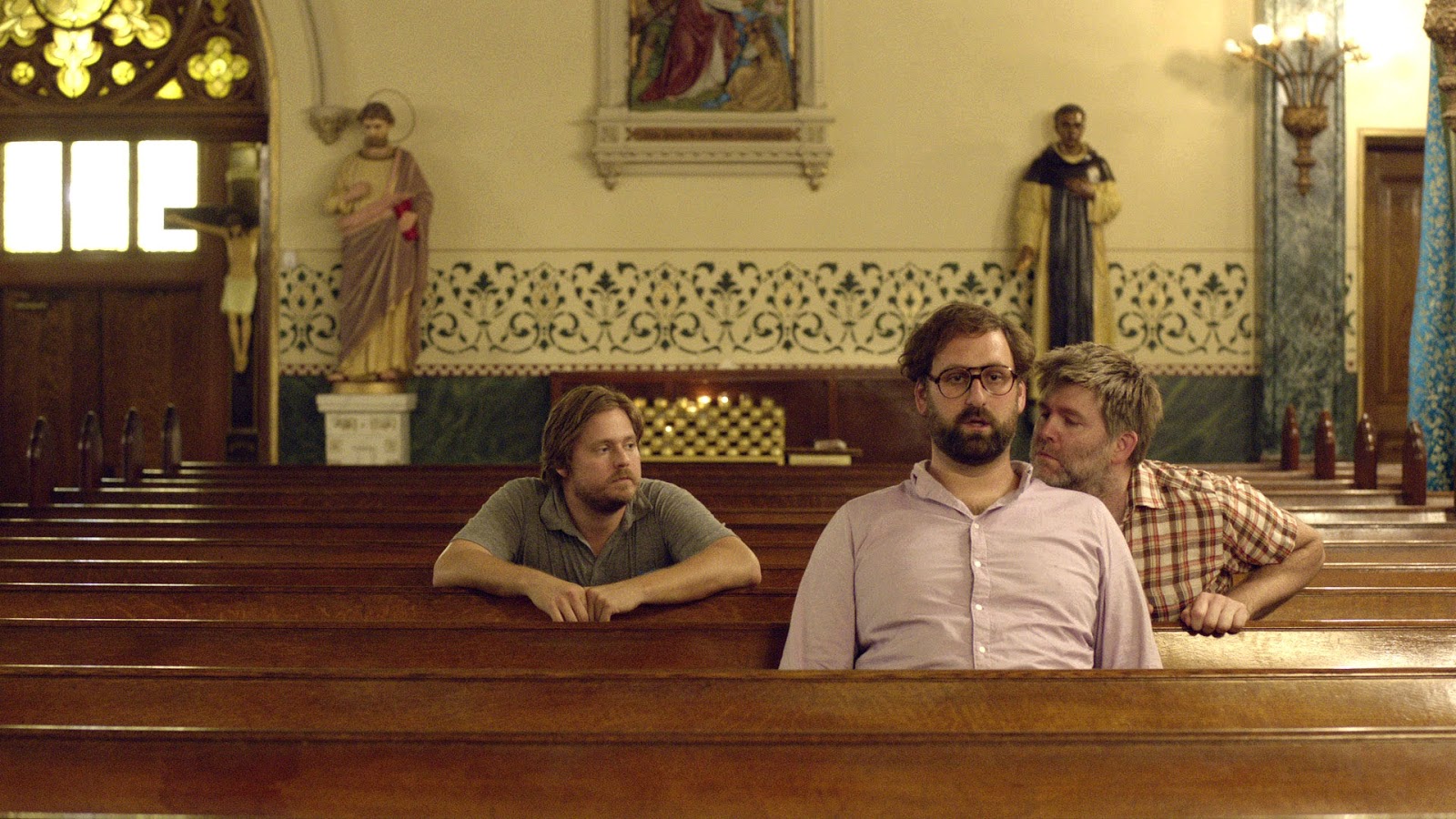
The setup of American Mary (which really seems like it should've been titled Bloody Mary but wasn't for fear of getting lost in a sea of IMDB entries) made me think of the gleefully nasty Pathology, but as it moved along I was also reminded of Girls Against Boys. Both comparisons are a bit too pat though: this is no medical horror, nor simply a battle-of-the-sexes vengeance flick. (There are distinct shades of Audition at times though, as you can see in the cap at the top of the page). Mary is a strange and stylized affair, and it sometimes feels like directors Jen and Sylvia Soska had more ideas than they really knew what to do with; Mary can feel like it's made up of material from three or four different movies.

Perhaps unfortunately, American Mary also reminded me of the phenomenal Excision, which similarly chronicles the psychic dissolution of a young, would-be surgeon. I say unfortunately because Excision is stiff competition for any film, and it's tough for Mary to measure up to Pauline, Excision's oddly endearing anti-heroine, who for my money is one of the most memorable horror characters of the last 20 years. But Mary is still interesting in her own right, and worth spending 100 minutes with.


While Mary left me with mixed (although ultimately positive) feelings, S&man (2006) is a film I genuinely loved. Where Mary spotlights the subculture of extreme body modification, S&man director JT Petty points his camera at horror filmmakers themselves. What makes S&man great is the same thing that opens it up for criticism: it honestly can't decide if it's a documentary or a scripted horror story. 

While it ends on a distinctly scripted note, the bulk of the film is an honest documentary, and a good one. That really is the great Carol J. Clover, who coined the term "final girl", intelligently discussing the through-lines between films like Henry: Portrait of a Serial Killer and the Abu Ghraib photographs. And those really are underground filmmakers Fred Vogel and Bill Zebub, discussing their own subterranean, DIY works (Vogel is behind the infamously depraved August Underground trilogy, while one of Zebub's movies is titled Jesus Christ, Serial Rapist).

But there's a fictional element too, in the form of the unassuming director Eric (Eric Marcisak, pictured above), the auteur behind the S&man series, which features the director stalking, tormenting, and strangling a series of young women. Initially framed as an extremely verite form of artificial snuff, director Petty begins to wonder how much of what he's seeing is "only a movie". (Marcisak's unnervingly normal performance is outstanding.)


I can see the argument that the scripted bits bring down the documentary sections, which feature some incisive and thoughtful interviews with Petty's principal subjects and really are surprisingly excellent. (Even as a diehard horror fan the idea of a documentary about horror filmmakers seems a little boring, but these folks have some fascinating things to say, and Petty draws them out expertly.) However, the sequences with Eric bring a crackling, nervous tension to the film, and some smart editing allows them to enliven and illuminate the talking heads' commentary—at some points, S&man is actually a better documentary for having scripted content.

One of the central ideas in S&man and in a lot of horror is the porousness of the border between illusion and reality, and more than one of the subjects of the film make the point that watching people die on camera for real can actually be surprisingly boring. In one of the film's best moments, when Petty asks Vogel if he's seen the decapitation videos made famous by terrorists and drug cartels, he notes that his first response was that Toetag (his production company) can do it better. 

It gets at the idea that horror isn't really about watching real-life violence, which tends to be messy, awkward, and without dramatic punctuation. If you want snuff, Youtube is full of videos from Syria showing real-life deaths that make A Serbian Film look like an episode of Family Guy. Horror isn't just about watching people die: it's about exploring the sense of dread that suffuses human existence, thanks to the curse of reason and the knowledge that death is inevitable. 

It's Romanticism with a capital R, where the subject is swallowed up in something vast, impossible, and terrifying. An innocent young girl falls prey to an unholy malady that distorts her very being; beautiful people in the prime of life are butchered by a stalker without a face; alien forces invade our bodies and rip their way out. At its best, horror is a stark encounter with what Damien Hirst called the physical impossibility of death in the mind of someone living—the title, fittingly, to a piece starring one of horror's primal figures: a big, dead-eyed shark.


Bon appetit.

Thursday, May 23, 2013

Confessions of a knife: Until the Light Takes Us (2008).


Norwegian black metal is a myth. It's a story filled with larger-than-life characters, startling events, and lingering mysteries. And for many, it stands as an irresistible beacon of authenticity (no matter how ugly), bereft of cynical market-based calculations.

But Norwegian black metal is also a myth because it has been mythologized. In one reckoning, churches were burnt by heroic, Siegfried-esque avatars of a resurgent paganism—but in another version, they were reduced to cinders by bored teenagers born into a placid and accommodating society. Viewed from a different angle, the saga of Norwegian black metal is not a grand, romantic tragedy, but just another tale of misspent youth, with a peculiar Scandinavian twist and some unusually tragic consequences.


I resisted watching Until the Light Takes Us for years for exactly this reason. I've grown weary of the mythological edifice that's been built around Norwegian black metal, mostly because it does a supreme disservice to a lot of great bands that have emerged since Varg's cell door slammed shut. There's also the fact that the music in question ranges from genuinely transcendent to criminally overrated, as is the case in most regional music scenes of legend. (I'll leave you to guess which is which; I will admit that I love Filosofem and most of the other Burzum records, but I think most of Mayhem's recorded legacy is indisputably awful).

But I'm happy to say that Until the Light Takes Us is a fascinating and worthwhile film—although maybe not for the reasons the filmmakers, Aaron Aites and Audrey Ewell, had hoped. It's also not without flaws, chief among them the fact that it contributes to the mythological edifice in one very significant and disappointing way, even as it tears another part of it down.

If you're looking for a definitive exploration of the Norwegian black metal phenomenon, look elsewhere; Moynihan and Soderlind's Lords of Chaos is the obvious destination, and it remains an excellent piece of reportage. Until the Light Takes Us does next to nothing to really contextualize the emergence of the black metal aesthetic, and record nerds are definitely going to be disappointed on this front. But frankly, this documentary isn't about music, as embarrassing as that might sound. It's about the scandal, and even more so it's about the people.


Specifically, two people: Varg Vikernes, the man behind Burzum, and Gylve Nagell (aka Fenriz), one half of Darkthrone. While Aites and Ewell speak with others, such as members of Satyricon and Immortal (and Bard "Faust" Eithun of Emperor, who in 1992 stabbed a gay man to death, and appears here as a voice-distorted silhouette), all of these characters are largely inconsequential. The movie is really about Varg and Fenriz, and how they've navigated an enormous myth of their own making.

The segments regarding Fenriz are notable for precisely how banal and prosaic they are: he comes across as a truly regular guy, and even a bit of a geek at times (such as when he finds a Testament tape in a street vendor's bin). Metalheads may be happy to know that Fenriz truly is one of them, down to the marrow of his bones—or they may be disappointed at how thoroughly he undermines the mythology (in which case, they probably haven't heard the last several Darkthrone albums).


Varg is a different story altogether. One ingenious trick the filmmakers use is to introduce him in voice-over, talking about Darkthrone; you don't know that you're listening to the man Sam Dunn aptly called "the most notorious metal musician of all time" until they cut to his iconic, almost cherubic face. On-camera, Varg is winningly charismatic and charming: whether recalling an anecdote from black metal's halcyon days or inveighing against Christianity, his speech is crisp and eloquent. (In a chilling moment, his demeanor doesn't falter at all as he describes Euronymous' murder.) He is an immensely fascinating character, and one can't help but think that maybe the movie should've just been about him.

But that's also part of the problem. Anyone well acquainted with Burzum and Varg's politics can have no doubt that Aites and Ewell probably filled several canisters of film/tapes/memory cards with Varg ranting about how the Jews are the greatest scourge humanity has ever known, and the inferiority of all non-Aryan races. Unfortunately, none of this (aside from an inoffensive comment about "Judeo-Christian" culture) makes it into the film.

From Varg's blog: how European musicians should look.

The result is a deeply flawed portrait of the film's central character, and one which can be corrected in seconds by merely glancing over the entries in his blog, which features such entries as "Crypto-Jews at large." While I firmly believe that Varg's artistic accomplishments should not be outweighed by his fringe politics (any more so than the work of, say, Ezra Pound), it's troublesome to see such a shallow portrayal in a film like this. Not just for being inaccurate, but because it contributes to the mythology built up around this milieu; Americans may have trouble mythologizing Varg after hearing about how he stopped playing metal because of its "Negroid" elements, and perhaps that's as it should be.

It's also a missed opportunity: one of the most interesting facets of the growing popularity of black metal with young music nerds outside the headbanger spectrum (who a less charitable commentator might call "hipsters") is the whole-hearted embrace of a band whose politics are essentially neo-Nazi. It speaks to both the decoupling of art from context in the era of streaming and file-sharing, as well as the non-committal political agnosticism of the typical hipster new Burzum fan in 2013. But Aites and Ewell pass over all of this without comment.


But they don't entirely miss the opportunity to comment on black metal going respectable, in much the same fashion as modern art taking its place in stodgy museums. A substory of the film concerns a local artist doing a black metal-themed showing in the former location of Helvete (Euronymous' record shop, Norwegian for "hell"). Speaking as someone who typically rolls his eyes at true guardians of metal who doggedly insist that anything outside the Von-Sarcofago-Darkthrone axis is false, I can still only describe this tableau as hideously embarassing. It reaches a climax when Fenriz himself visits the gallery, looking as bewildered and uncomfortable as humanly possible when confronted with the awkward spectacle of his younger days. It's a scene worthy of The Office.

In the end, Until the Light Takes Us is basically a treat for the fans. Whether they want to worship at the altar of Varg or pillory him will depend on the viewer. I suspect the filmmakers were aiming a bit higher than this, but the last word on the scandalous heyday of black metal this is not. And it's hard not to think that such a definitive account will never emerge, for the simple reason that Euronymous, one of its most central actors, isn't here to provide his version of the story.


Endnote: a much more revealing and interesting depiction of the genre is provided by the YouTube documentary "One Man Metal", which profiles three modern descendents of Burzum: Xasthur, Leviathan, and Striborg. I thoroughly enjoyed this doc for its resistance to hoary Norway worship, and for its shockingly intimate portraits of the three artists.

The sight of Malefic hanging out on a park bench wearing a backwards LA Kings hat (!) no doubt rustled many a metalhead's jimmies, and would certainly be decried in the strongest possible terms by the teenage incarnations of Euronymous and Count Grishnackh—but after seeing the stark, intense isolation of his lifestyle, it's tough to say that the hateful, misanthropic streak in his music isn't for real. After all, even Burzum had friends.

Monday, April 8, 2013

The people who grinned themselves to death: The Comedy (2012).


The Comedy was reportedly shot in 15 days, using only an 18-20 page treatment, with the lion's share of the film emerging from improvisation. This is not exactly surprising, given the players involved, but it's still impressive, because every instant of The Comedy feels perfectly controlled. This isn't an aimless indie curiosity like The Brown Bunny or Gerry; even though it's a film without much in the way of dramatic conflict or rising action, it still has a laser-beam sense of focus, and never wastes a single second.

The Comedy is the "story" of Swanson, an aging, terminally jaded Williamsburg hipster facing the imminent death of his wealthy father. Swanson passes his time lounging on his boat, taking jobs he doesn't need, and engaging in endless competition with his "friends" to see who is the most disaffected. (The scare quotes are practically mandatory here, as saying this film features a story or friendship would be simply inaccurate, like saying it's a documentary about women in Afghanistan.)

In some ways, the film that The Comedy most reminds me of is Man Bites Dog, a similarly warped character study that also mixed moments of jet-black humor with grotesque sociopathy. The only thing missing is Man Bites Dog's startling bursts of violence, but The Comedy is no less brutal for their absence. Ironically (ironically), Ben, the serial killer protagonist of Man Bites Dog, ends up being much more likeable than Swanson.


At times, The Comedy also reminded me of the excellent Martha Marcy May Marlene, as both films drift leisurely through a series of uncomfortable moments that gradually cohere into a profile of a deeply damaged person. They're also both anchored by an astonishing central performance.

The role of Swanson was tailored for Heidecker by director Rick Alverson, who thought the way that Heidecker exploited "awkwardness" with comedic partner-in-crime Eric Wareheim (also in the film) would perfectly suit the character of Swanson. Many critical responses to the film have focused on the idea that Heidecker is somehow skewering his own demographic, but I think a crucial point is missed here. 

The M.O. of Heidecker and Wareheim's comedy (both on Tim and Eric Awesome Show Great Job! and their even-better prior offering, Tom Goes To the Mayor) is absurdity. One of the best recurring sketches on Tim and Eric is the saga of Carol, a lonely secretary (Wareheim) who is hopelessly in love with her ludicrously callous boss (Heidecker). Carol's desperate, unrequited love and her boss's casual cruelty are both rendered in the most exaggerated possible terms. 

Bathos is a key element of the show, as exalted sentiments and emotional rawness always arrive in the most ridiculous manner possible (often during advertisements and infomercials). But Tim & Eric is never purely about mocking its characters, no matter how pathetic they are: a figure like Dr. Steve Brule remains stubbornly lovable, partly because of what a screw-up he is.


The Comedy is different. Swanson's sensibility is pure schadenfreude, verging on sociopathy, and while his jaded, vacuous self-absorption may seem exaggerated, it's really not. Nothing that happens in the film seems beyond the pale, or enters into the realm of surreality where Tim and Eric takes place. It's all painfully real, and that's what it makes it so effectively off-putting.

There's a great quote from the blogger Bike Snob NYC (an early adopter when it comes to mocking hipsters) that has stuck with me. In response to a Craigslist "missed connections" posting by a Williamsburg aesthete, he wrote:

You know, I'm not one of these people who whines about the gentrification of New York City, and I suspect that many of those who do complain about it weren't around to experience the theft, violence, and urine first-hand. (Well, the urine's still around, so you can sample that all you want.) That said, there is a price to pay for a better quality of life, and that price comes in the form of giddy, puckish, whimsical, kite-flying dandies like you. Tragically, now that the sharp corners have been padded and the electrical outlets have been child-proofed, Brooklyn has become a giant romper room for latent adolescents who are free to traipse about at all hours unmolested. So I find myself conflicted. I don't want another crime wave, yet I do want one to come crashing down on you like a tsunami on a big wave surfer.

Such is the experience of watching Swanson; you're constantly waiting for somebody to kick his ass. But there is also real pathos in The Comedy, albeit of a very muted kind: a moment of tenderness between Swanson and his sister-in-law, or (spoiler alert) the film's final scene, a genuinely warm vignette of Swanson frolicking with a little boy on the beach. 

It's a credit to Alverson that he includes these scenes, allowing them to complicate the central character—even if only slightly. It makes the film more than just a screed about the vacuousness of the shopworn hipster archetype, and it certainly separates it from the day-glo, public-access nightmare of Tim and Eric.


But it's Heidecker, the connoisseur of the absurd, who really makes this film. His performance here is a revelation: there are elements of his other characters, but Swanson is his own man, without precedent or ancestor. And while there's none of Tim and Eric's funhouse exaggeration to blunt the character's sharp edges, there's also a profound sense of loss lying just behind his aloof, stubbly mask. 

Swanson is a kind of inverted Patrick Bateman: where the American Psycho antihero was a psychopath passing himself off as human, Swanson is a human being impersonating a perfectly emotionless observer, assuming an archly ironic stance towards all of existence. He treats the world like a playground for his own amusement, but nothing that he does (save perhaps playing in the surf at the end) is ever actually fun. It's a haunting, tour de force performance.

The Comedy also feels like a requiem for a moment that's already passing away. As a figure of widespread cultural disdain, the ironic hipster is beginning to be supplanted by newer, decidedly un-ironic characters: the hysterical Tumblr blogger, the "brony", the Men's Rights Activist. The best proof that irony as a reigning mode is passing away is how much attention is being paid to it—and after The Comedy, it's hard to imagine that there's even much left to say.


Tuesday, August 21, 2012

Hard to be human again: Kill List (2011).


Kill List is a messy movie, literally and figuratively. There's a lot going on within its lean 95 minutes, and more than a few viewers did not hesitate to call foul. Roger Ebert—a brilliant critic whose prose style nonetheless usually leaves something to be desired—struck the bullseye in his review, delivering an appropriately jumbled verdict: "It's baffling and goofy, blood-soaked and not boring. That it's well-made adds to the confusion; it feels like a better film than it turns out to be." 

But what's really maddening is the fact that, well, it is a better film than it turns out to be. Part kitchen-sink crime story, part jagged suburban nightmare, and part Wicker Man homage, Kill List is ambitious, brutal, and mesmerizingbut it's also murky, asymmetrical, and hard to like. It's reminiscent of the work of Michael Haneke (Funny Games) and Gaspar Noé (Irreversible) in that it combines precise, expert craftsmanship with decisions that seem designed to purposefully alienate the viewer. It's the kind of movie you can't stop rolling around in your head after watching it—partly because you're probably trying to settle on whether you actually liked it or not.

It's definitely a horror movie, but in a very particular way. There's nothing supernatural or otherworldly on tap here, only the sordid ugliness of man. The film revolves around Jay (Neil Maskell) and Gal (Michael Smiley), a pair of soldiers-turned-contract killers who go to work for a mysterious, sinister "Client." Despite their grim vocation, Jay and Gal are wisely depicted as ordinary, likable men who happen to kill people for a living. Gal is the archetypal charming Irish rogue, while Jay is a high-strung but loving family man whose tumultuous relationship with his wife (MyAnna Buring) is one of the film's focal points; the film opens with a domestic screaming match over their vanishing bank account.

A tense dinner party scene early in the film is as absorbing as any of the murders seen later, perfectly capturing the kind of casual cruelties and simmering resentments that mark a marriage balanced on a razor's edge over financial ruin. Before we come to know the central duo as killers, we come to know them as people.


As it happens, Gal is also a Catholic (albeit more culturally than anything) while Jay and his wife are unrepentant atheists (reminder #2 that you're not watching an American movie, after the acccents), and the first target on their list turns out to be a priest. But this fact proves to be little more than a speed bump, as Gal casually notes that they should be thankful that their quarry isn't a little kid; unlike a lot of movies with the familiar "no women, no kids" hitman's code of honor, you get the sense that working class anti-heroes Jay and Gal probably would take a job targeting women and children—but they would do so reluctantly, and they certainly wouldn't be happy about it. There is little moralizing in Kill List, and what we do get is agreeably warped, like when one of our anti-heroes makes the hilariously qualified claim that "I've hardly done any terrible shit."

The relationship between Jay and Gal is the best part of Kill List, and in their rough-edged gallows humor and back-slapping camaraderie we can recognize our own friends, brothers, fathers and sons. But their separation from us is also total, because, after all, they kill people people for a living. And they do so very dispassionately: while plotting how to attack the priest, Jay makes a joke about how they should probably surveil him for a while rather than just shooting him down on the street in a hail of bullets, and his affect is akin to an office worker discussing a broken copier.

And indeed, the violence in Kill List is sudden, drained of glamor, and almost casual. It's also sometimes quite hard to watch, even for a seasoned veteran of horror film gross-outs like myself. There's a scene with a hammer that puts even Drive's to shame in terms of sheer visceral impact; it's in the same category as the stomach-churning opening scene from Frayed, although I don't know if it quite outstrips that one.


You may not be surprised to discover that as the film goes on, things get worse. Maskell's performance proves to be one of the film's greatest assets as Jay becomes increasingly unglued, a simmering cauldron of post-traumatic anger and violence. Again, there are no overt horror histrionics on display, and that's part of what makes the film so strangely successful: Kill List positively seethes with menace, and it does so without falling back on stale cliches. A big contribution comes from Jim Williams' music and Martin Pavey's sound design, filling everyday shots of suburban streets and neatly trimmed lawns with baleful, ominous dissonance.

[Warning: spoilers ahead.]

It all leads up to the ending, which is the point where you decide whether your accounts of the movie to friends will be filled with cursing. All along the way the film has been scattering breadcrumbs suggesting that there's something even more ominous at work beyond casual brutality and murder for hire; you get the sense that "the Client" may have enlisted Jay and Gal in service to some kind of dark pagan lord or tentacled elder god, slouching towards Sheffield to be born.

The film's climax is interesting for how on the nose it is, considering that Kill List is a film that seems to delight in vagueness and questions left unanswered (e.g. what happened to Jay and Gal in Kiev). But it also works, almost in spite of itself; the finale is full of eerie visual details and assaulting sonics that seem like the logical culmination of the whole film's patient, boiling sense of dread.

The biggest problem with the film's last moments is sort of an accident of timing: they are remarkably similar to the ending of A Serbian FilmSrÄ‘an Spasojević's controversial 2010 shocker, and both movies seem to share nearly identical story arcs. But these movies are awfully close to each other chronologically for Kill List to be consciously emulating A Serbian Film, which makes me think they arrived at their respective twists of the knife independently. 

And if you ask me, Kill List works better than its more notorious counterpart on every level. When I finally got around to seeing A Serbian Film, the latest entry in the "most transgressive film ever made" sweepstakes, I was a little surprised and disappointed at how cartoonish it was—a judgment that seems borne out by Spasojević and writer Aleksandar Radivojević's comments that the film was apparently intended as a parody of political correctness (a message that may or may not be supported by the end product).


As shock cinema's latest enfant terribleA Serbian Film is certainly disturbing—but it's also so gleefully over-the-top that its final dark revelation seems painfully obvious, and as a result lacks the revolting horror it should properly have. The vibe of Kill List is entirely different: it's The Jesus Lizard to A Serbian Film's Cannibal Corpse ("Hammer Smashed Face" allusion entirely intentional), eschewing rote signifiers of brutality in favor of something rawer and more genuinely disorienting. There's a brilliant moment right after the film's final reveal, when the frame freezes and a grating feedback tone sweeps up to nearly deafening volume—and for a second, I really didn't know what would happen next. Would we cut to the credits? Would Jay's head suddenly explode? Would my TV? Would Satan, laughing, spread his wings?

Some movies are easy to like. It's virtually impossible to honestly hate on something like, say, Shaun of the Dead. But Kill List is not such a movie. It never seems like it cares about winning you over, but it also doesn't seem like it's trying to piss you off; it's never sophomoric or exploitative. It just is—and as such, it's very much in the native British tradition of "kitchen sink" filmmaking. It's messy, difficult, harsh, and overwhelming. But somehow, almost in spite of itself, it's also very good.

Monday, August 13, 2012

Horror noise goody bag: unpacking the new Blue Sabbath Black Cheer.

I'm not usually one to wig out over new vinyl. This is because

(1) Literally everyone is a record collector now;

(2) Most new vinyl releases these days are reissues of records that sucked the first time, cynically repressed by those hoping to cash in on the bubble before it bursts; and most importantly,

(3) I am a contrarian asshole.

That said, I was blown away by the insanely lavish new Blue Sabbath Black Cheer release, The Boundary Between the Living and the Deceased Dissolved, on Equation Records. This is the fanciest physical release I've seen since the Floor box set, and frankly it makes that fine product look like a 10th generation mix tape caked in vomit.

But shitty pictures are worth the proverbial thousand words:


Here's the cover, complete with glare obscuring the awesome artwork. That neat sticker lets you know all about the cornucopia of goodies you're about to crack open, like a sugar-addled child busting up a piñata.


The two LP sleeves are held together with MAGNETS! (Hold your ICP jokes please.) I thought this was pretty ingenious. I hate gatefold sleeves though.


Okay, so here's what's on tap in the first sleeve. You get a one-sided etched 7 inch which is dedicated to The Cherry Point, and--surprise!--features crunchy, HNW style rumble. Honestly I probably won't ever listen to it again (7 inches, especially one-sided ones, really aren't the ideal HNW format if you ask me), but it does come with a  bunch of neat little art cards. And you also  get a boatload of stickers (featuring uplifting messages like "FUCK YOUR SCENE" and "IT DOESN'T MATTER WHEN YOU ARE DEAD"), plus a giant, '80s-style 2" button with a little piece of the cover artwork! And wait, is that a fucking slipmat in there?


Yep. Pretty sick! (Also, the 7" is red, a fact sure to please all the dorks who still think colored vinyl is the most revolutionary invention since movable type. You also get the label from the etched side, so that you can glue it onto some other 7 inch and confuse yourself later.)


So what's in sleeve number two? Well, you get the album itself, which is also one-sided and features a beautiful silkscreen on the flip side (see below). There's more gorgeous inserts, a numbered certificate (out of 235) and even a kind of BSBC sampler CD with rare and unreleased stuff! I really appreciated this last, as most labels would've been content to throw in a download code or just neglect digital altogether--but I still love CDs, and it's cool to get extra songs on top of the LP.


Here's the gnarly silkscreen. The LP itself shreds too: it's more in the vein of "classic" BSBC than the 7 inch, starting off with ominous chiming cymbals and gradually snowballing into a blizzard of graveyard noise.


There's also a special message ("READ ME FIRST" at the top) detailing an unfortunate printing/shipping mishap where the ink was still wet when it got put in the white inner sleeve. 
"We apologize for this faux pas. But, on the plus side, extricating this record will involve a little wanton vandalism: ripping, tearing, and injury to the sleeve - which is condoned by the band and heartily encouraged; especially while listening to the other audio contents of this package." 
The message says nearly every copy was affected, but actually I don't think mine was, as the 12" slid out of the sleeve with no problems. I like to think some collector nerd out there is stewing in anguish over this, while I feel a little cheated that I didn't get to rip my record out of its sleeve like a Kali-worshipping witch doctor tearing out some Christian missionary's heart.


What's inside the CD sleeve? More stickers! Again, with most releases you'd count yourself lucky to get a single sticker, but Equation and BSBC throw enough at you to wallpaper your mini-fridge with grim propaganda.


I forgot to mention you also get a sweet 12" x 24" poster of the cover art! Here's a better worse different picture, taken after I threw it into a spare frame I had lying around for that letterboxed effect:


So, all in all, pretty awesome. I don't think it's too much of a stretch to say that this is one of the coolest releases I've ever seen. It costs $36 and is apparently being sold at cost, a claim which I totally believe. I think it's definitely worth the scratch if you're even a casual fan of BSBC; if Corrupted releases were packed with this much cool stuff I'd feel a lot better about paying $30+ for them. (Of course, if Corrupted ever makes the complete archival box set I've dreamed of, it will probably make this look like an RRRecords release and cost approximately $10,000.)

Like I said, it's limited to 235 copies and I don't know how many are left, but check it out at http://www.chronoglide.com/Equation_releases.html.

Wednesday, August 1, 2012

Tweets ahead: Detention (2011).


Before we proceed, it should also be noted that Detention is a movie that, on paper, I thought I would absolutely hate. Everything I read described it as a fast-paced, disorienting paean to the mash-up age, a kind of Scream for the Twitter era. And while this description is apt, it also fails to do justice to what makes this movie so special: namely, its middle-finger intelligence (pictured), kinetic visual style, and a boundless enthusiasm that manages to break through its own Kevlar vest of referential irony to deliver something surprisingly thoughtful, and even touching.

But Detention is very much a love-it-or-hate-it movie. The algorithmic magic of Rotten Tomatoes suggests that coin-flip figure should be revised upward: I was honestly a little surprised to find that the film has a lowly 31% rating. But the user reviews tell a different story, with Detention earning a solid 66%.

Is this evidence of the yawning generation gap between a stodgy cadre of baby boomer film critics and a younger viewership of smartphone-wielding teenage hooligans? Or is it the same old critical snobbery towards anything even resembling horror that we've seen hundreds of times before?


Sony Pictures gamely attempts to summarize Detention as an "apocalyptic fantasy, horror, science fiction, action-thriller, body swapping, time-traveling teen romantic comedy", but even this mouthful falls short of capturing the film's dizzying sweep. Put simply, Detention is the teen movie to end all teen movies.

It's a 500 MPH live-action comic book gene-splice, with dominant and recessive traits from Buffy the Vampire Slayer, Skins, John Hughes, Shaun of the Dead, Degrassi (if upgraded to a hard R), Heathers, Mark Millar, Buckaroo Banzai, Clueless, and about a thousand other reference points that whiz by like bullets fired from a pop culture AK-47.

In the growing pantheon of self-aware horror films, Detention occupies a unique niche: it may not be quite as charming as Shaun of the Dead or as artfully composed as Behind the Mask, but it has so much youthful zeal and raw energy that it nonetheless shoots straight to the head of the pack. And compared to, say, Shaun of the Dead's expert mix of horror and humor—a balance which could probably be confirmed by an electron microscope—Detention leans much further towards comedy, with the horror usually arriving as a welcome, bloody surprise.


I really think the closest point of comparison for Detention's singular style is Dan Harmon's brilliant and beloved sitcom Community, which seems to win critical esteem in direct proportion to how fast Detention loses it. Grizzly Lake and Greendale CC feel like they come from the same universe: the "schmitty"-spouting teen twerps that torment Jeff and Britta in one episode could have escaped from Riley's science class, and a slightly younger Abed would blend seamlessly into the film's cast (where he would instantly recognize Riley's Angela Chase costume at Sander's party).

Yet Community earns endless (and well-deserved!) critical accolades while Detention languishes, far from earning even a "Fresh" rating. Why? Again, blame the generation gap: while Community often culls material from fare like My Dinner With Andre or John Woo's The Killer, Detention's more masscult sensibility alludes to decidedly gauche sources like Steven Seagal or Saw.

But one piece of Detention's technicolor pop mosaic stands out to me as evidence of the subtle taste and sophistication that makes it so special: despite very ample opportunity, filmmaker Joseph Kahn resists the impulse to make his Breakfast Club references anything but oblique. Like fireworks prior to child safety regulations, postmodernism is a dangerous toy: witness the cloying, candy-binge preciousness of Juno, or the painfully try-hard pyrotechnics of Scott Pilgrim Vs. the World. But Detention is the movie that these and many other entries of the past few years were supposed to be.


Sometimes Detention admittedly feels more like a series of vignettes than a movie, and towards the end the quantum whipcracks of the plot do become a little vertigo-inducing. But that's all part of the fun, and also part of the point in a movie which features at least half a dozen kitchen sinks. 

Plus, it's hard to complain when there are so many loopy highlights: a hilariously left-field, Spider-Man style digression regarding the origins of "TV Hand"; a movie-within-a-movie-within-a-movie-within-a-movie; a deadpan tour through 19 years of pop fashion courtesty of "the silent enigma" Elliot Fink (Detention's equivalent of Pulp Fiction's dance contest); and the alien abduction of an extraterrestrial, time-traveling bear. (Yes, really.)

So, watch Detention. Realize that there's a good chance you'll hate it—but if you do, you can at least take comfort in the fact that you're not alone. 

Then again, maybe you're just old.

Friday, June 8, 2012

A terrible beauty is born: Prometheus.


In our media-drunk era, Prometheus has already earned plenty of vituperative bashing online.  This is, I think, entirely predictable: it had tons of hype, and represented a renowned creator returning to a beloved, longstanding IP which is cherished closely by a sizable subset of the population. (A subset to which, it should be noted, I myself belong.) 

For a sample, visit the IMDB user reviews page. Most of this "criticism" is delivered in the lingua franca of the internet, that familiar idiom of hyperbolic, childish tirade: "ruined forever", "pure vomit in film form", "written by a 10 year old", etc. It's a bit ironic that this dipshit dialect would be used to denounce the supposed watering down of a classic piece of popular art. Such is the culture consumption of late capitalism: see the movie, and either "like" it on Facebook or post a steaming, apoplectic denunciation using tenth generation, recycled "Comic Book Guy" tropes.

This is a clear instance where the traditional media, sputtering from its deathbed, still plays a valuable role. Newspaper critics have been much more balanced: Slate's razor-sharp reviewer Dana Stevens skewers the film's lapses in logic and explanation, while still lauding the film's dazzling visuals and sheer craft; Kenneth Turan and A.O. Scott deliver many of the same judgments but offer a stronger view of the film overall; and Roger Ebert doesn't hesitate or hedge in calling it "magnificent" and awarding it four stars.

The truth? Prometheus is flawed, but brilliant. It sometimes underwhelms, but it frequently overwhelms. It is narrow and mythic at the same time, and often a sense of skin-deep shallowness hides a surprising, almost Romantic depth. It is a film that leaves much unsaid, which is both its greatest strength and its biggest weakness. In the end, it is a towering achievement, a lofty vision that is wholly unconcerned with the insects nibbling at its heels.

If you're as fanatical about the Alien movies as I am, then take it from me: you really, really owe it to yourself to go see Prometheus without having anything spoiled for you. Having seen it, I can better appreciate the shell game played by Ridley Scott in the months leading up to release: is it an Alien movie, or isn't it? If you love the series, don't let anyone tell you the answer.

That said, I can't imagine trying to talk about the movie without heavy spoilers (for reasons I'll get into), so consider this fair warning.

SPOILERS AHEAD! DON'T READ UNTIL YOU SEE IT!


Prometheus takes place in the late 21st century, and concerns the eponymous science vessel's search for the origins of mankind in the far reaches of space. Archaeologists Elizabeth Shaw (Noomi Rapace) and Charlie Holloway (Logan Marshall-Green) have discovered a recurring pictogram in a wide range of ancient human civilizations, which provides a map to a distant solar system capable of sustaining life. 

With generous financial backing from Weyland Industries (and let me tell you what a treat it is to hear a smooth, computerized voice chirp "building better worlds"), the Prometheus sets out on a journey to find these interstellar benefactors, whom Shaw and Holloway call "Engineers."

The ship is crewed by a motley assortment of scientists and spacefarers that more or less fall into a generic template. Among others, there's Meredith Vickers (Charlize Theron), a ball-busting ice queen overseeing the mission for Weyland; the ship's captain (Idris Elba), who suggests Al Matthews' gruff-but-good-hearted Sgt. Apone from Aliens; a pair of wisecracking pilots who recall Harry Dean Stanton and Yaphet Kotto's grease monkeys in Scott's 1979 masterpiece (down to their concern about "shares"); a prickly, tattooed geologist who is clearly earmarked for doom; and, of course, there's Shaw, who is this film's Ripley. (Which is not to say that the character is much like the iconic Warrant Officer.) Perhaps most notably, there is also David (Michael Fassbender), an android progenitor of Ash and Bishop from the Alien films.

Prometheus is utterly, shockingly beautiful. Shot in a cold, Gigerian color palette tempered with bursts of shipboard, electronic warmth (sound familiar?), it's the kind of movie where every few seconds there's a shot suitable for framing. I found the opening scene—which chronicles a mysterious suicide, and its consequences—absolutely riveting, and a captivating blend of the Romantic (the tiny individual literally swallowed up by nature) and spectacular sci-fi. This sense of wonder didn't ever really flag until the credits.

For me, part of this may be due to the fact that Prometheus is intensely, overwhelmingly reminiscent of Alien. This is most immediately noticeable with our first glimpses of the Prometheus, where the deserted bridge, sterile compartments, and hypersleep chambers seem very much like a deliberate homage to the Nostromo. It also, somewhat surprisingly, takes more than a few pages from James Cameron's Aliens (which is my favorite movie of all time)—most notably with the obligatory hangar bay briefing scene, and a violent homage later in the film.

At this point, I should note that the performances are a mixed bag. Logan Marshall-Green, as Holloway, is woefully out-of-place and almost instantly annoying, and for me he was one of the film's real weak points; I found myself wishing that Guy Pearce had taken his role, instead of being buried beneath a thick layer of makeup for a two-scene cameo as Peter Weyland. Theron and Elba are satisfyingly workmanlike, and though they don't really have much to do they are—as usual—endlessly watchable. 

Rapace really delivers, and though her protestations of not aping Ripley are fully justified, her combination of vulnerability and toughness (the "cesarean" scene is a great example of wordless, physical acting) is very much in the tradition of Sigourney Weaver. As many critics have noted, the most compelling performance comes from rising star Fassbender, whose David is a studied, coldly aloof and childlike creation; appropriately, he makes later models like Bishop (or even Ash!) seem much more human.

Okay, so let's just cut to the chase. Far from a George Lucas style retcon (or an unrelated property cashing in on franchise association), it's surprising how much of the bedrock of Prometheus' mythology is held over from the original Alien. The Engineers that the crew of the Prometheus are seeking happen to be the same race as the "Space Jockey" discovered in the first Alien (and who Scott originally envisioned using the xenomorphs as bioweapons), and LV-223 is discovered to be a kind of military installation, housing numerous ships like the one fatefully explored by Kane, Dallas, and Lambert. It is also a kind of weapons storage facility, housing thousands of small "vases" (which may remind you of something) containing a mysterious black substance, which is quickly revealed to dramatically mutate life forms it comes into contact with.

Although it's purtportedly a military installation, the eerie murals and artful decoration of the alien outpost suggested something else to me. All through the latter part of the film, I kept thinking of Aum Shinrikyo, the Japanese cult infamous for releasing sarin gas on the Tokyo subway system in 1995. I couldn't help seeing the Space Jockeys as a splinter sect from the Engineers, a kind of alien death cult who have their own form of bioweapon to release on humanity (or the galaxy), bringing about the apocalypse. And that maybe, in the end, Shaw would find the answers she was seeking.

Of course, this is all just speculation. Which brings up the film's biggest weakness: the script. Penned by Lost co-creator Damon Lindelof, it has a sense of generic vagueness and frequently backslides into cliche. Where Lost had a long-form format to string out its mysteries and deepen its initially stock characters (e.g. rock star junkie, haunted soldier, con man with a heart of gold), Prometheus has just two hours. As as a result, the characters (even the good ones) gain little dimension, and often serve as little more than plot devices. One of the biggest examples, for me, was the snap decision by the two pilots to go down with the ship at the end: up to that point, we had no reason to think of them as self-sacrificing.

But this basic lack of depth and explanation is largely overshadowed by the broader mythos and mystique of the incredible world Scott and company create. The Engineers, their civilization, the black goo—it all provides an irresistible desire to know and to understand in the same way that Lost did at its best. (A theme which also happens to be exactly what the film is about.) For every forehead-slapping piece of dialogue, there's another picturesque scene beckoning the viewer with a grand sense of otherworldly strangeness.

Along the way, there are more and more tantalizing allusions to Alien, from the look of the alien vases to a number of very facehugger-like mutated creatures. It all culminates in the revelation of the cockpit that the film's Space Jockey was originally found in—and in the film's final minutes, the suggestive link between the films teased by Scott is made very explicit. Perhaps the most remarkable of these moments for me was a brief glimpse of an engraving in one of the Engineer outpost's chambers: the camera lingers on an abstract, silvery image that could be a Rorschach blot, but which looks unmistakably like an alien queen.

In the end, Prometheus is a staggering visual feast, and a smorgasbord for Alien obsessives. It's worlds away from, say, Avatar, and I much prefer Prometheus' grand, mythic sweep to that film's reheated, space-born Dances With Wolves. Even if the characterization and detail doesn't always cohere, Prometheus more than compensates by providing a brand of dark, existential sci-fi that has been sorely lacking at the box office.